Clinical innovation in a single weekend
On a Friday afternoon in April, Jon Riise, Head of the Department of Oncology at Oslo University Hospital, asked Andreas Kleppe, Research Director at the Institute for Cancer Genetics and Informatics, whether ICGI’s AI expertise could be used to develop an application that would simplify the complex process of planning doctors’ work schedules.
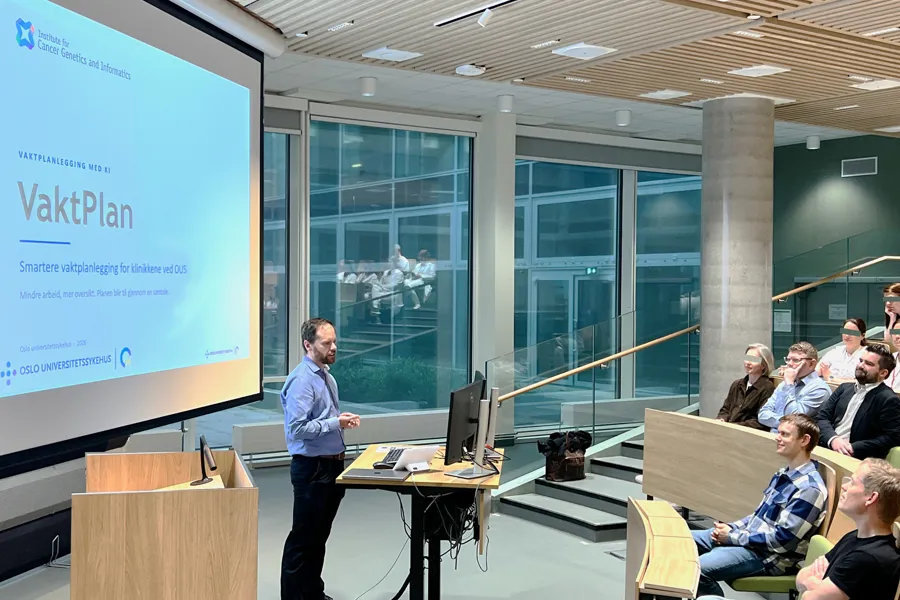
Photo: M. Seiergren
“It is difficult not to be impressed by how quickly Andreas Kleppe and Sepp De Raedt understood what we were trying to achieve and translated it into a working prototype,” says Eivind Storaas, Assistant Head of Department at the Department of Oncology (AKB).
Together with Jon Riise, Head of AKB, he highlights the close collaboration between clinicians and developers as an important success factor.
“It has been inspiring to see how committed the ICGI team has been to understanding the clinic’s responsibilities in patient care. In a short time, they have turned this insight into a solution with clear value for everyday clinical practice,” says Riise.
ICGI has over 20 years of experience in advanced image analysis, digital pathology, and AI to improve cancer diagnostics and prognostication.
Since April, developers from ICGI have worked closely with oncologists to further develop a new work-scheduling application for the clinic. Close dialogue, rapid feedback and continuous adjustments have resulted in an improved prototype, which is now being tested at the Section for Breast Oncology.
“ICGI’s strength is that we have broad expertise in software development and AI. The distance from idea to prototype is short – days rather than months or years,” says Kleppe.
The project demonstrates how artificial intelligence can address specific, practical challenges in clinicians’ daily work, streamline time-consuming manual tasks, and enhance overall workflow.
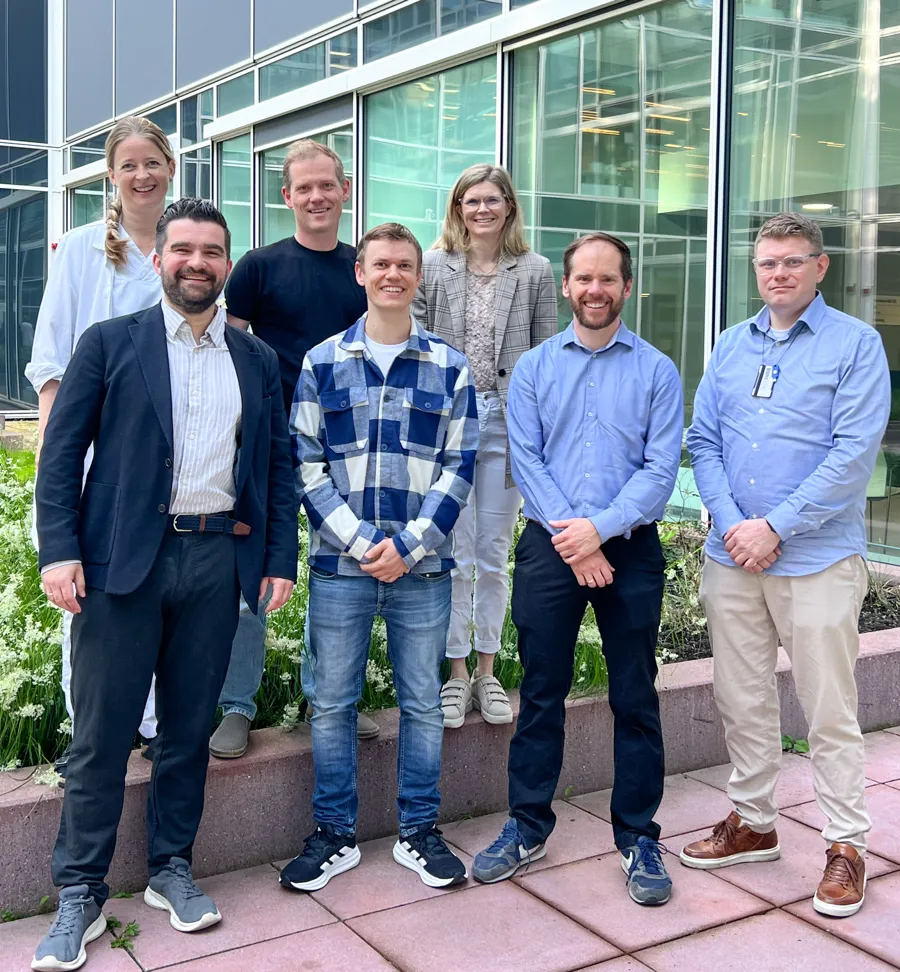
Photo: M. Seiergren
From left, in front row: Eivind Storaas (AKB), Andreas Kleppe (ICGI), Sepp De Raedt (ICGI), Bård Erik Nilsson (TIK)
A helping hand in clinical planning
Preparing doctors’ work schedules requires expertise, time and patience. Planners must balance a wide range of factors, including service requirements, regulated working hours, capacity, specialist competence, holidays, sickness absence, parental leave and individual needs..
Riise and Storaas estimate that around one per cent of senior consultants’ time at AKB is currently spent on work scheduling. Much of the planning is done manually in Excel, making the process cumbersome and time-consuming.
A key benefit of the new solution is that schedules can be planned further ahead. This gives doctors greater predictability and makes it easier to ensure continuity in patient care, especially in outpatient services.
The prototype has been developed using AI-supported code generation. The code has subsequently been adapted, further developed, and quality-assured by developers at ICGI to ensure that the solution meets both AKB’s needs and the hospital’s requirements.
Usability has been a key priority throughout the development of the application.
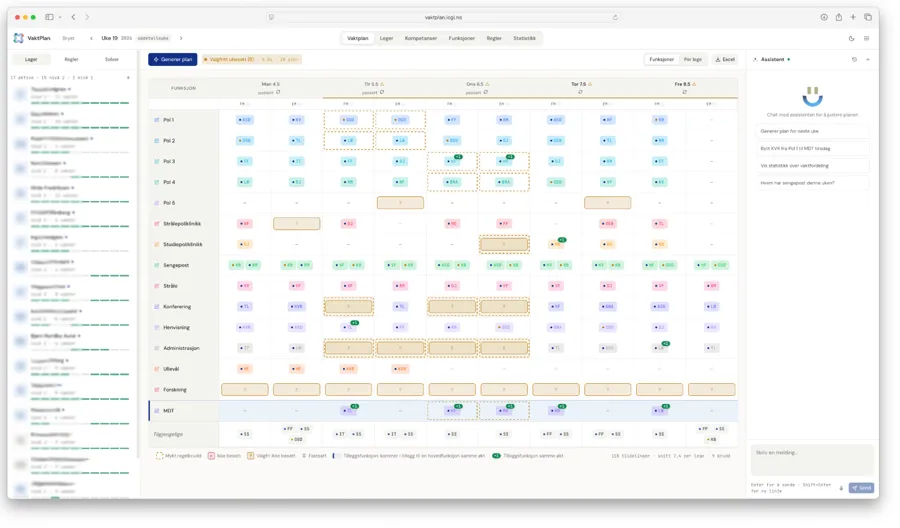
Sepp De Raedt, System Developer at ICGI, explains that they have integrated an AI assistant that understands everyday language, allowing users to interact with it in the language of their choice, such as Spanish, Arabic or Norwegian.
Hanne Frydenberg at the Section for Breast Oncology has played a central role in testing the solution in the clinical setting where it will be used.
“The user interface is far more intuitive than managing work schedules manually in Excel, and the chat function is an added benefit, especially when changes need to be made,” she says.
Security
The application only handles work-related information that planners already have access to through their role, such as names, competence, availability and adaptation needs. It runs on a dedicated server in a segregated hospital network with GPU capacity, so that all AI processing takes place locally.
“Role-based access, separation between sections and departments, and the fact that the application does not process sensitive data all support compliance with the strict security requirements at Oslo University Hospital,” says Bård Erik Nilsson, ICT Adviser at the Division of Technology and Innovation (TIK).
Further development
The project is still at an early stage. Although the prototype is now being tested in clinical practice, the solution will continue to be further developed.
Commercial systems for planning doctors’ work schedules exist, but they can be less flexible and may require time-consuming and costly procurement and adaptation processes. By developing a smaller, local solution in close collaboration with the doctors and planners who understand the clinical context, the project has quickly produced a useful tool.
“This is a good example of user-driven innovation,” says Line Kristine Greve, Assistant Head of TIK, who helped connect AKB and ICGI.
“We know from the e-health literature that the value of IT depends on context. Value is created where local requirements, the right expertise and available governance meet,” adds Storaas.
Greve emphasises that needs-driven solutions must also be considered alongside existing systems and initiatives to ensure coherence, scalability and appropriate use of resources.
Several sections in AKB, as well as departments in other divisions, have already expressed interest in testing the application.
“The potential for useful and sustainable local innovation through close dialogue between technological and clinical expertise is still largely untapped in the healthcare service,” concludes Kleppe.