End-to-End Pathology for Advanced Cancer Prognostics
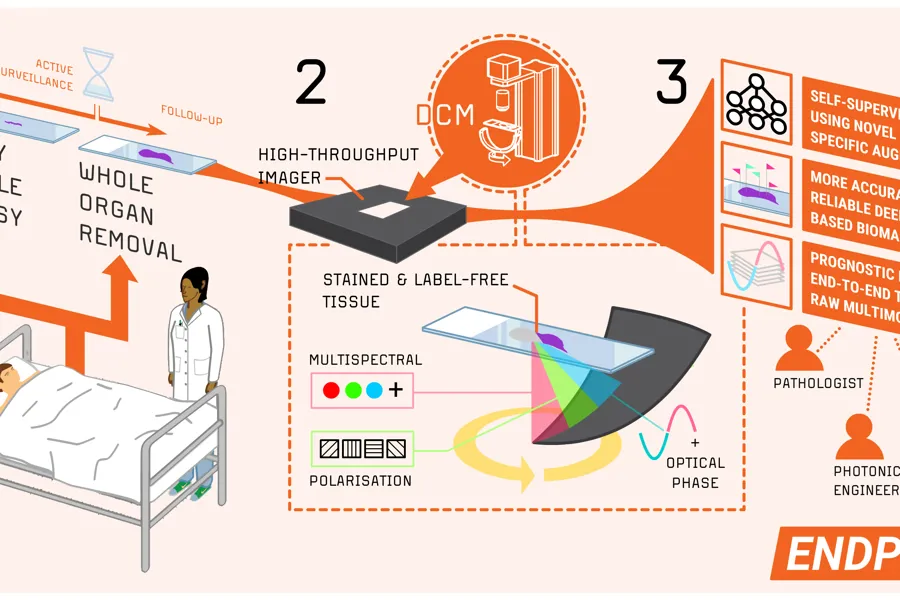
ENDPATH is developing a new imaging system for digital pathology, specifically designed to train artificial intelligence (AI) models for precise and reliable diagnostics and prognostics of cancer. The project aims to optimise the entire analytical pipeline – from optical imaging of unstained histological specimens to deep learning analysis – to improve the accuracy and robustness of next-generation diagnostic tools.
Expanding the Information Base in Histopathology
For more than 150 years, haematoxylin–eosin (H&E) staining has formed the foundation of histopathological diagnosis. However, current digital slide scanners primarily record colour and intensity. Other physical properties of light, such as phase and polarisation, are largely unused.
ENDPATH leverages Digital Condenser Microscopy (DCM) to capture these intrinsic physical properties. Unlike slower, more complex research modalities, DCM allows for fast, cost-effective acquisition while preserving an image appearance familiar to pathologists and compatible with existing clinical decision frameworks. By continuing the development of a high-throughput DCM prototype, we aims to create the first multimodal microscopy system built natively for advanced deep learning.
Clinical Application
We will conduct a large-scale study based on more than 2,000 samples in order to demonstrate the potential of this imaging system to provide AI models that are more accurate and reliable than those based on conventional microscopy images. Simpler diagnostic tasks such as automated tumour segmentation and Gleason grading will be followed by more complex tasks such as prognostic modelling.
Initially, the project will focus on prostate cancer, the most common cancer among men in Norway. More than 6,000 Norwegians are currently monitored under an active surveillance protocol, where accurate risk assessment is essential to avoid overtreatment. The project will utilise large patient cohorts available at the institute to develop AI models that may improve decision support for personalised treatment strategies.
A FRIPRO High-Risk, High-Reward Project
ENDPATH is funded through FRIPRO, a programme of the Research Council of Norway that supports ground-breaking research. The project is classified as high-risk, high-reward, aiming to develop new technology with the potential to transform how digital pathology is used in clinical research and diagnostics.
In the longer term, the project may contribute to a transition from traditional digital pathology towards more comprehensive in silico pathology, where imaging technology and AI-based analysis are developed as an integrated system.
Collaboration
This interdisciplinary project, led by the Institute for Cancer Genetics and Informatics at Oslo University Hospital, is supported by an advisory board and collaborators from leading academic institutions, particularly from the University College London (UCL), University of South-Eastern Norway (USN), and University of Oslo (UiO).