FRIPRO funds for groundbreaking research in digital pathology and artificial intelligence (AI)
Research leader Andreas Kleppe was in June 2025 awarded funding from the Research Council's prestigious FRIPRO program for the project ENDPATH – End-to-End Pathology. The project aims to develop a new type of imaging system for digital pathology and use the more detailed images to train precise and reliable artificial intelligence (AI) to determine the disease progression of cancer patients, initially focusing on patients with prostate cancer.
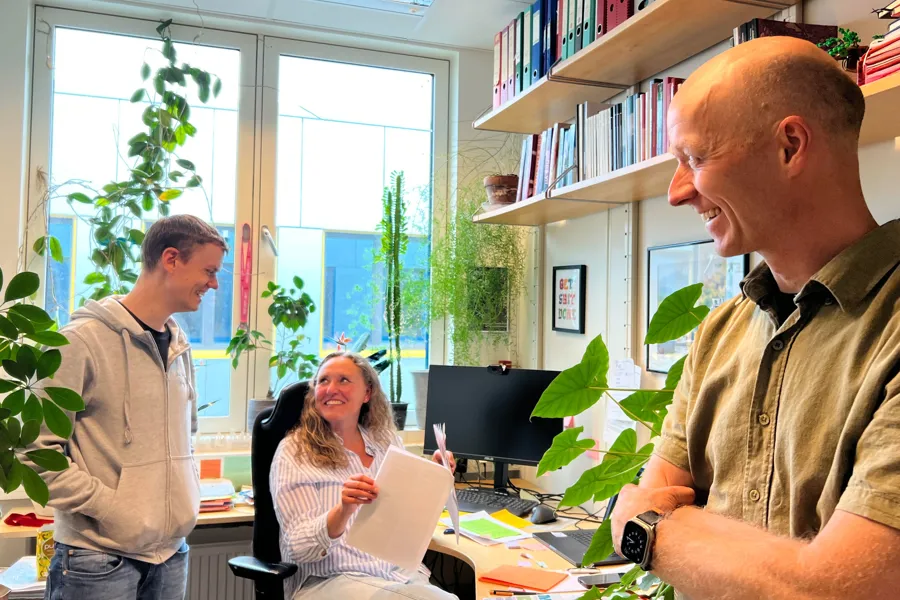
Photo: Marian Seiergren
Unlike today's imaging systems that are adapted for visual assessment by humans, the new system will be tailored for automatic analysis using artificial intelligence.
ENDPATH – a boost for digital pathology
Digital pathology is now being implemented in hospitals across the country, opening up new opportunities in diagnostics, research, and artificial intelligence. Pathologists diagnose and contribute to treatment choices, often based on H&E-stained tissue samples. For nearly 150 years, pathologists have analyzed tissue samples using this staining method and microscopy. The imaging systems currently used in digital pathology are designed to provide pathologists with similar images. Most AI models developed for digital pathology use the same images, but both the staining and the imaging system limit the information contained in the images.
The ENDPATH project removes these limitations by developing an imaging system that captures images of tissue samples without staining and utilizes all properties of light - amplitude, phase, and polarization. This provides a richer data foundation for the development of AI models and facilitates more precise and robust tools in the future of digital pathology. In the project, this will be exemplified by developing AI models that will indicate the risk of rapid development of prostate cancer from images of biopsy samples. Although the new type of images may be difficult for pathologists to interpret directly, they can be simplified to produce images that resemble the H&E-stained tissue samples that pathologists are accustomed to.
Intense competition – high quality
FRIPRO is a national competition arena for groundbreaking research, and there is fierce competition for funding. Only applications that receive top scores on all assessment criteria are qualified for financing. Andreas Kleppe and his project being among the selected is clear evidence of both quality and originality. “In FRIPRO, we are willing to invest in bold research that has the potential to make significant advancements in the field, even though it also carries a significant risk of failure,” writes the Research Council. The Department of Cancer Genetics and Informatics has solid experience with digital image processing and is ready to explore new horizons and shape the next generation of digital pathology.
Read more about ENDPATH on the English research website of Oslo University Hospital.